Charles Edwards Saleyards
The Drover's WifeCharles Edwards Saleyards is Everton’s principal livestock market, where droving, wool commerce, and the town’s growth converge. Named for Charles Edwards, an early pastoral settler, the yards are both a practical destination for sale-day business and a visible marker of the economic system that shapes local livelihoods.
Setting and Development
The saleyards stand within a town built around a stock route and the movement of sheep. Charles Edwards had proposed developing the nearby outpost of Cresthill into a town, arguing that the route and the arrival of farmers and settlers would make it prosper. His promise to help finance development linked the district’s settlement ambitions to the pastoral trade, while the stated premise that Aboriginal people had to be dispersed exposed the coercive frontier policy behind that expansion.
The Edwards family’s fortunes later helped carry those plans forward. Frank Neville Charles Edwards built a profitable business selling local wool in Melbourne to overseas markets, supporting work for farmers and drovers as well as the family’s commercial standing. Yet the economic depression weakened the wool enterprise and endangered Everton’s final stage of development. Construction eventually began, adding to the jailhouse, troopers’ quarters, Stanlow Inn, general store, and postal house; Frank made completion of the new saleyards a priority before the district’s next major sale.
The Sale-Day Market
When Nate Clintoff arrives, freshly erected wooden posts and rails enclose renovated holding yards, and a new sign reads ‘The Charles Edwards Saleyards’. The name commemorates Charles Edwards, who came to the area in the 1820s seeking better grazing for his sheep. The market’s imposing name thus joins present-day commerce to the earlier pastoral occupation of the district.
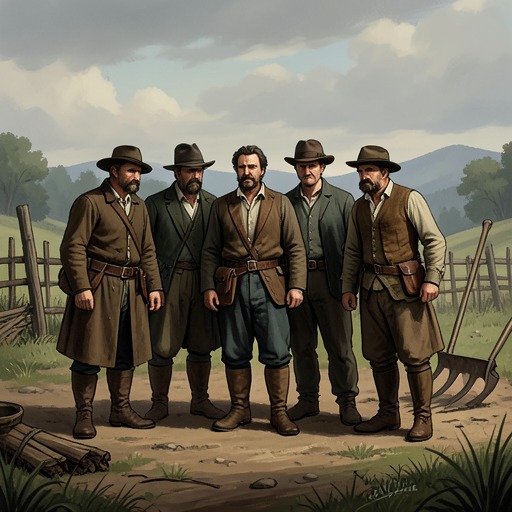
The yards are crowded with livestock, stockmen, businessmen, and farmers watching the sheep in the pens. Auctioneers walk the top rails, describing breeds and quality; men air saddles and saddle blankets on fences, feed and groom horses, and check hooves. The din combines bleating, business, laughter, arguments, and stories from recent droves. Those stories are expected to travel beyond the market and grow more daring in their retelling, making the yards a meeting place for both trade and drovers’ talk.
Work, Precarity, and the Search for Joe Johnson
The market’s bustle rests on hard, mobile labor. In a regular pattern lasting nearly eight years, Joe Johnson and his droving companions meet sheep brought down from Queensland, take them to the high country for three months, then bring them back before the first snowfall for sale. One recent drove involved fifteen thousand sheep. That cycle provides household income, but the collapse of the sheep industry and the depression make the work and the family’s future less secure; Molly Johnson fears that her twelve-year-old son Danny may soon have to leave home to earn a living droving.
The drovers’ skill also determines who reaches good grazing and market first. Joe and Robert Parsen are known for moving their herds efficiently, rarely losing livestock, and seeking the best prices. Their work ties the yards to a far wider network of stock routes, but its rewards do not erase the vulnerability of families dependent on a depressed industry.
Nate comes to the yards looking for Joe, Molly’s husband, and asks a group of stockmen whether they know where he is. Bruce Longley says Joe is not with his own crew and asks the others; Marti, a woman in her early forties whom Nate initially mistakes for a boy, thinks Joe has gone with Robert Parsen’s team, which has already left. The search makes the busy market a point of contact between local working knowledge and the investigation unfolding in Everton.
Narrative Significance
The saleyards concentrate the novel’s economic and social pressures in one place: sheep arrive from distant routes, local labor gathers around them, and the town’s prospects depend on wool and sale-day commerce. Their development reflects the Edwards family’s ambitions, but the same expansion is connected in the narrative to dispossession and the forced displacement of Aboriginal people. Against the noise and abundance of sale day, the depression’s damage is already apparent in the uncertain future of wool, Everton’s incomplete development, and the precarious household economy of the drovers’ families.